Steam backlog statistics 2026: how many games do players never launch?
Short answer: in a random sample of 280 public Steam libraries we pulled in October 2026, 28% of all owned games had never been launched, and another 14% had been played for less than an hour. But the typical account is nowhere near that bad. The median library holds 7 or 8 games with 1 never opened. The real pile of shame belongs to a minority: the biggest 10% of libraries own 60% of every never-launched game in the sample.
Key takeaways
- 28% of games in public Steam libraries show zero minutes played. In 2014 the corrected figure was about 26.5%.
- The median account owns 7 or 8 paid games and has never launched 1 of them. Libraries of 100+ games, 7% of the sample, leave 30% unlaunched at the median.
- The top 10% of libraries by size hold 60% of all never-launched games.
- At today's US store prices, the never-launched games in a typical 50+ game library list for $385 at full price, or $97 at this week's Autumn Sale prices. Almost nobody paid that.
- The method that works for players is not a buying ban. It is a short list, permission to quit, and a random pick when you are stuck. We turned that into the Five-Game Shelf below.
On this page: What we found · Stats you have seen, checked · Why the pile grows · What players say · The Five-Game Shelf · Tools · FAQ · Method
What we found in 280 random Steam libraries
We picked random Steam account numbers across the whole range of accounts that exist today, kept the ones whose game libraries are public, and read the playtime Steam records for every paid game in them. Free-to-play games are left out, because Steam only lists those once they have been played. The full method and its limits are at the bottom of this page.
One finding came before any of the backlog numbers: only about one Steam account in ten shows its game library publicly. Of roughly 5,200 real accounts we hit, about 525 let us see their games, and about 325 owned at least one paid game. That matters for every backlog statistic you will read, including ours, because the people who leave their library open may not be typical.
28% of games have never been launched
Across 8,719 paid games in 280 libraries, 27.8% had zero minutes of recorded playtime. Allowing for sampling error, the real figure is most likely somewhere between 24% and 31%. That is close to the corrected 26.5% from Ars Technica's 2014 Steam Gauge study once it corrected for Steam's playtime tracking. Twelve years and a lot of sales later, the share of Steam games nobody opens has barely moved.
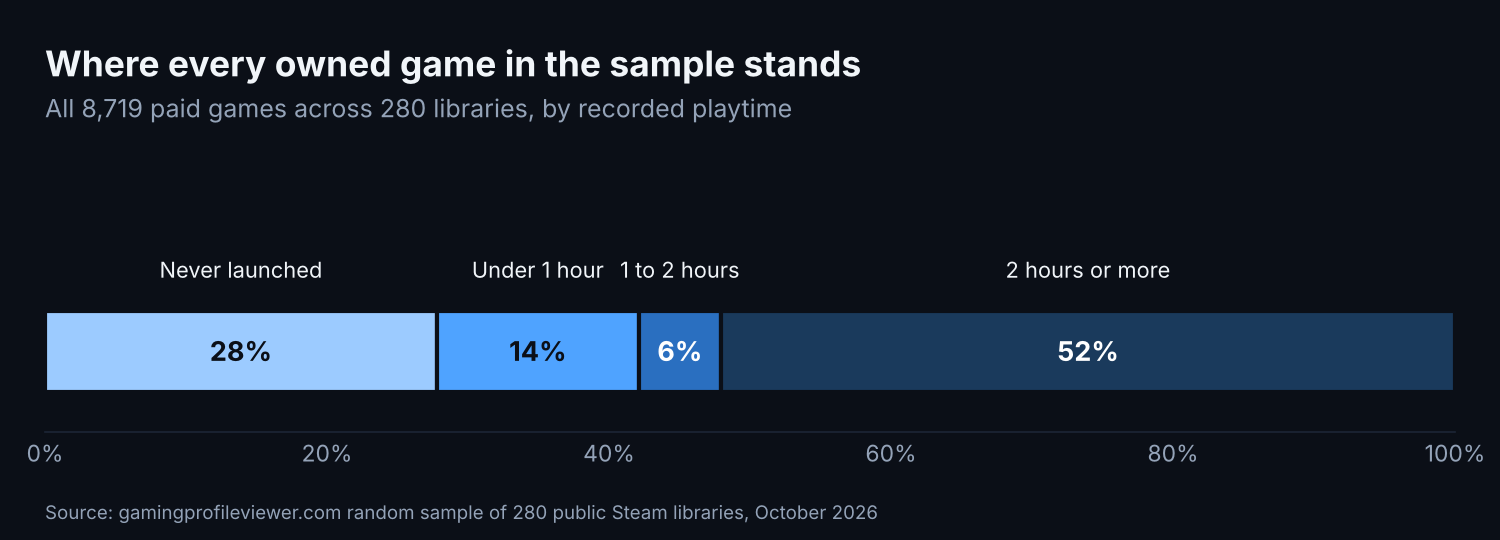 Almost half of all owned games (48%) have under two hours on record. Source: our random sample of 280 public Steam libraries, October 2026.
Barely touched adds another 20%
Another 14% of games were played for less than an hour, and 6% for one to two hours. Put those together with the never-launched games and 48% of everything people own on Steam has under two hours of play, which is also the cut-off for Steam's refund window. The typical library leaves 40% of its games under that line.
Most people barely have a backlog
This is where the averages mislead. The median library in our sample holds 7 or 8 paid games and has exactly one it has never launched. 38% of libraries have no never-launched games at all. Only 15% have left half or more of their library untouched.
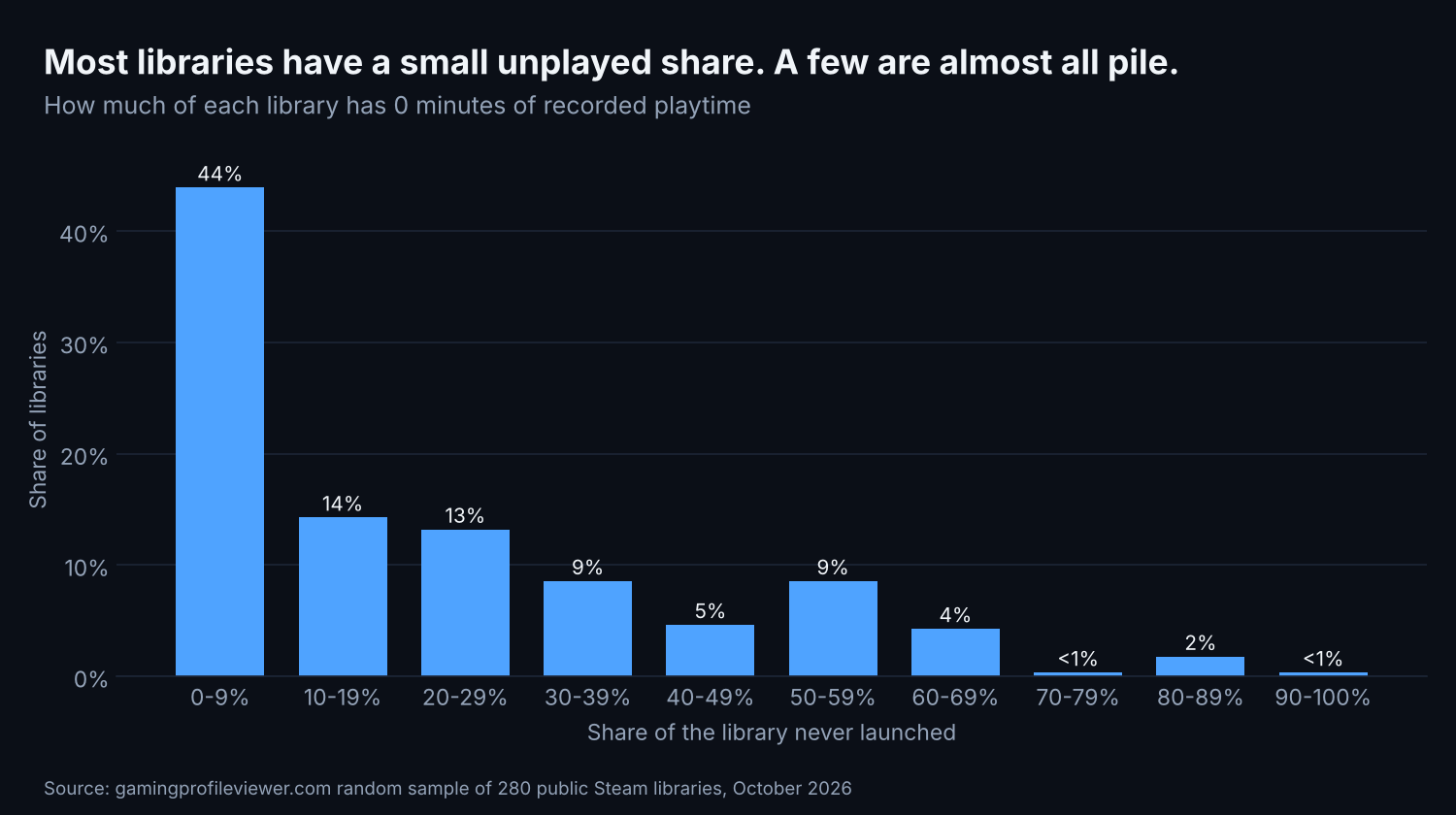 Most libraries have a small unplayed share. Source: our random sample of 280 public Steam libraries, October 2026.
That is why our median (14% of a library unlaunched) looks so different from the 51.5% median GameDiscoverCo reported. A random account on Steam is often someone with a handful of games. GameDiscoverCo has not said how its profiles were chosen, but any sample built from people who look up their own stats would lean towards bigger, older libraries.
The pile belongs to collectors
The biggest 10% of libraries in our sample (84 games or more) own 60% of every never-launched game we found. The biggest 20% (45 games or more) own 78%. Partly that is just because they own more games overall, but they also skip a bigger share of them.
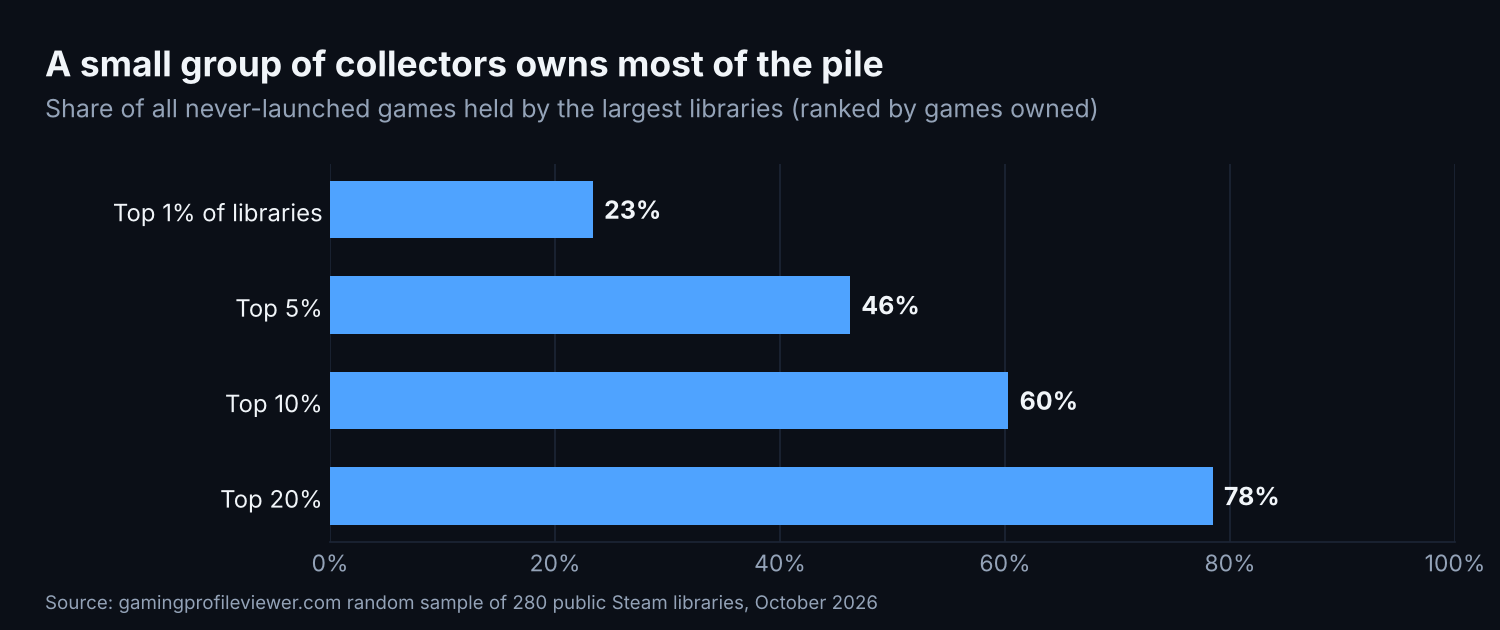 A small group of collectors owns most of the pile. Source: our random sample of 280 public Steam libraries, October 2026.
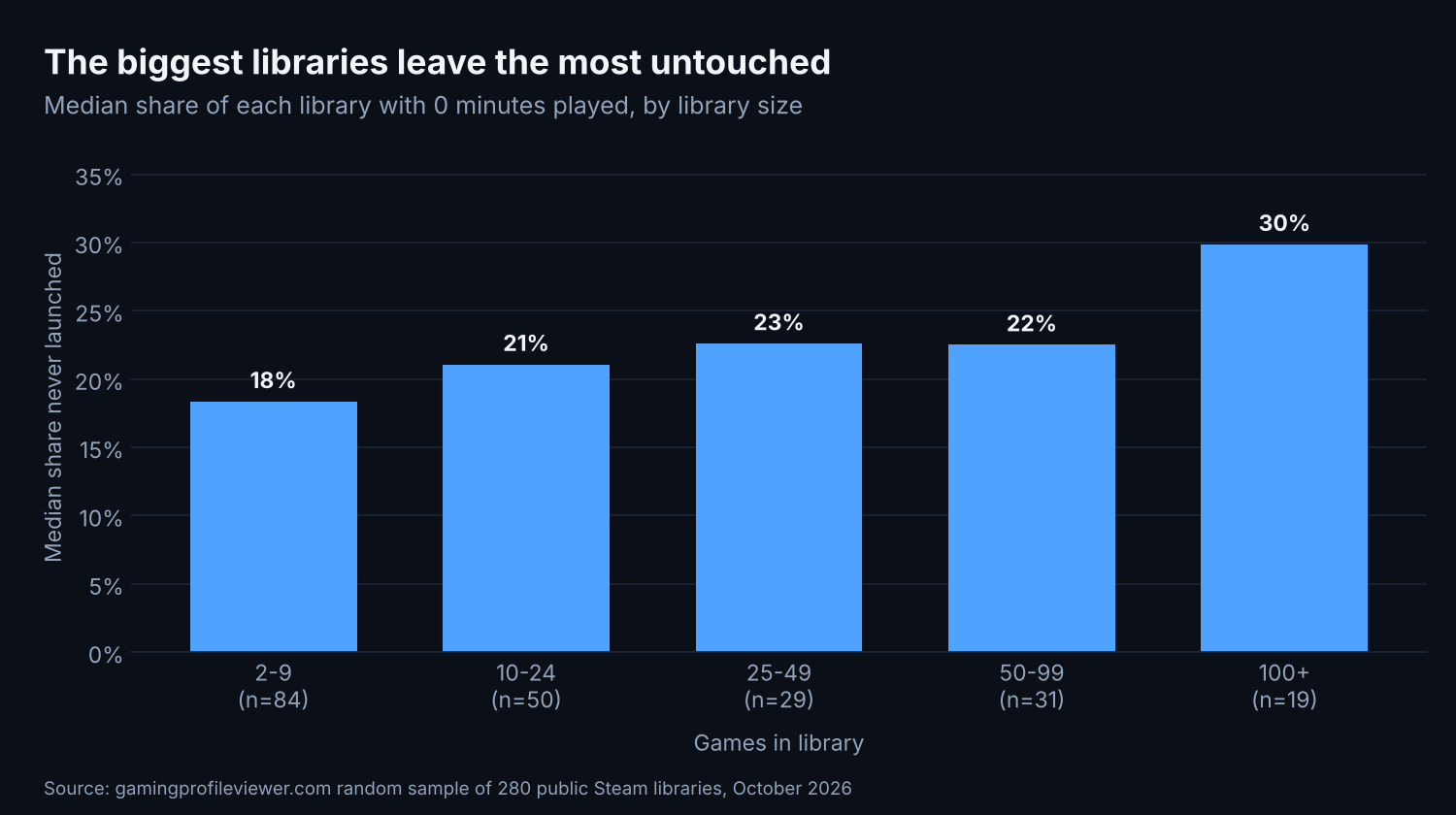 The median library of 100+ games has 30% of it unlaunched. Group sizes are small, so treat the steps between groups as rough. Source: our random sample, October 2026.
The median library of 100 or more games in our sample owns 145 games, has never launched 42 of them, and has played another 24 for less than an hour. That is the backlog people actually mean when they talk about a pile of shame.
Older accounts carry the biggest piles
Accounts created in 2014 or earlier had a median of 48 paid games and 10 never launched, and nearly half of them owned 50 games or more. Accounts from 2015 onward had a median of around 8 games and 1 never launched. Older accounts have simply sat through more sales, bundles and giveaways.
The games people own and never open
The most common never-launched games in our sample tell their own story. Of the 15 games that turned up unlaunched most often, 12 cost their owners nothing: automatic upgrades, extras bundled with another game, or free-to-keep giveaways. These counts come from the 169 libraries where we kept game-level detail, so they show a pattern rather than a ranking.
| Game | Libraries that own it | Never launched | How most people got it |
|---|---|---|---|
| Grand Theft Auto V Enhanced | 30 | 18 | Free upgrade for GTA V owners, March 2025 |
| ARK: Survival Of The Fittest | 19 | 16 | Released free for everyone in 2016 |
| Warhammer 40,000: Gladius | 12 | 12 | Free to keep on Steam, May 2026 |
| Warhammer: Vermintide 2 | 16 | 10 | Free to keep on Steam, November 2025 |
| Black Desert | 13 | 10 | Free to keep on Steam, several times |
| Half-Life 2: Deathmatch | 11 | 10 | Given free to Half-Life 2 owners |
| Little Nightmares Enhanced Edition | 11 | 10 | Free upgrade for owners |
| Half-Life Deathmatch: Source | 10 | 10 | Included with Half-Life: Source |
| Company of Heroes 2 | 12 | 9 | Free to keep on Steam, 2019 and earlier |
| Little Nightmares | 11 | 8 | Free to keep on Steam, May 2021 |
| Metro: Last Light Complete Edition | 10 | 7 | Free to keep on Steam, May 2023 |
| House Flipper | 10 | 7 | Free to keep on Steam, April 2026 |
Further down the list it is the same story: Skyrim Special Edition, BioShock 2 Remastered and Metro Exodus Enhanced Edition, all handed to people who already owned the original. A fair chunk of what looks like a backlog is a library filling itself in.
What the pile is worth (and why the $19 billion figure is wrong)
We priced every never-launched game in the 169 libraries where we kept game-level detail at the US Steam store on October 2, 2026, which happened to be day two of the Autumn Sale. About three in four had a current price. The rest were delisted, bundle-only or free.
- The average priced never-launched game lists for $19.21, and was selling for $6.03 that day.
- For libraries with at least one never-launched game, the median pile lists for $50 at full price and $15 at sale price.
- For libraries of 50 games or more, the median pile lists for $385 at full price and $97 at sale price.
Those are store prices today, not what anyone paid. Many of these games came free (see the table above) or in bundles and deep sales. That is the core problem with the $19 billion headline from 2024: it valued every game at its current store price rather than what people paid, and multiplied a $1.9 billion sample by ten. Our numbers say the typical backlog is worth tens of dollars. A collector's can list for hundreds, but at the prices people actually pay, the money is probably smaller than the guilt.
Every backlog stat you've seen, checked
Backlog numbers get passed around for years after anyone checks where they came from. Here are the ones that keep showing up, and what the source actually says.
| The claim | Where it came from | What is actually true |
|---|---|---|
| "37% of Steam games have never been played" | Ars Technica's Steam Gauge project, April 2014 | Ars corrected it to about 26.5% once it accounted for Steam only tracking playtime since March 2009. It is also 12 years old. |
| "Steam players own $19 billion of unplayed games" | PCGamesN and SteamIDFinder, June 2024 | The data covered about $1.9 billion across public profiles, valued at current store prices rather than what people paid, then got multiplied by ten. Ars Technica took the maths apart the same month. |
| "The median player has 51.5% of their library unplayed" | GameDiscoverCo newsletter | A real figure (the mean was 32.7%) from "tens or hundreds of thousands" of public profiles, but with no sample size or selection method published. Our random sample puts the median account at 14%, and libraries of 100+ games at 30%, which suggests theirs leaned toward bigger, more engaged libraries. |
| "Only 10% of players finish games" | A 2011 CNN report | It came from Raptr data on one Red Dead Redemption mission plus a developer anecdote. A 2019 study of 725 Steam games found a mean of 14% of players reached the end of the main content (median 10%). Close, but now with a real method. |
| "79% of Steam is people playing old games" | Alinea Analytics, July 2026 | That figure is revenue, not playtime: 79% of estimated H1 2026 Steam revenue came from games released before 2026. The playtime figure comes from Valve and is in the next section. |
Why the pile keeps growing
Most play goes to games you already own
Valve's own year-end numbers show how little room new games get. In Steam Replay 2025, only 14% of all playtime went to games released that year. 40% went to games eight or more years old. In 2024 the new-release share was 15%.
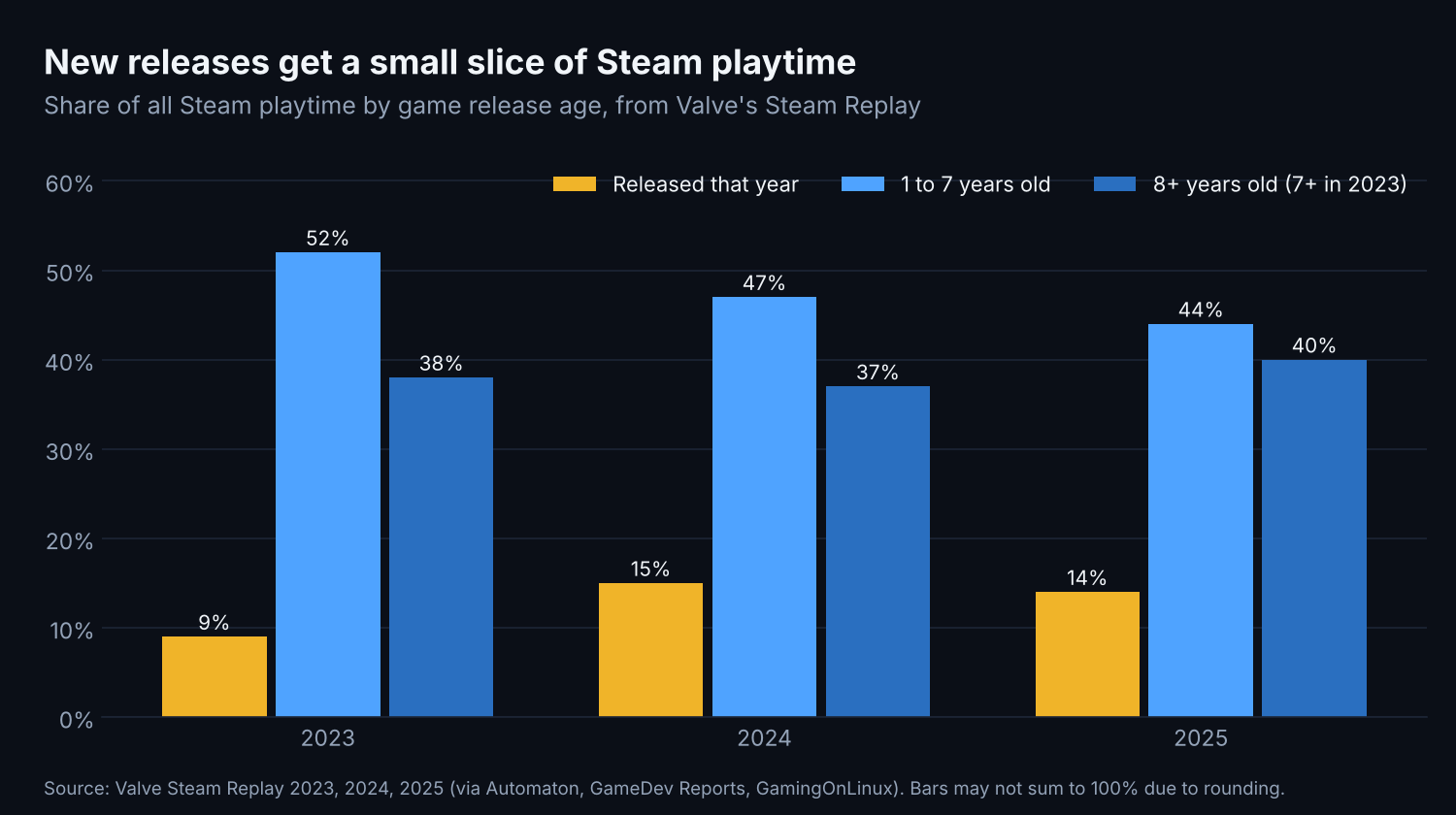 New releases got between 9% and 15% of Steam playtime each year from 2023 to 2025. Source: Valve Steam Replay, via GamingOnLinux, GameDev Reports and Automaton.
So players keep returning to the same few games while the library keeps growing around them. A GYLD analysis published by SuperJoost in August 2026 found spending on 16,565 Steam games released before 2024 rose 26% in the first half of 2026 compared with a year earlier, while average daily players per game fell 10%. More buying, less playing, of the same catalogue.
Sales and bundles are built for this
Steam notifies wishlisters when a game drops 20% or more for longer than eight hours. Every seasonal sale is a reason to grab something at 80% off, and bundles pack in games you never went looking for. Free-to-keep giveaways work the same way with no price at all: Warhammer 40,000: Gladius, Vermintide 2, Black Desert and House Flipper were all giveaways, and all four are among the most common never-launched games in our sample.
Players know it too. A May 2026 IGN, Kantar and UC Berkeley survey found 62% of the most engaged players no longer buy games at full price. Many of the top comments on Bellular's 3.2 million view video about Steam wishlists describe the wishlist as a sale tracker, not a shopping list.
Buying for a future self who never shows up
There is a well known version of this outside gaming. Economists Stefano DellaVigna and Ulrike Malmendier found gym members on monthly contracts paid more than $17 per visit when a $10 pass was available, because people overestimate how often they will go. A sale purchase works the same way. You are buying for the version of you with free weekends.
Too much choice, sometimes
"Choice overload" gets cited a lot in backlog articles, usually through the 2000 jam study where shoppers facing 24 jams bought far less often than those facing six. The honest version is narrower. A 2010 meta-analysis of 50 experiments found the average effect was close to zero. A 2015 follow-up found overload does show up under specific conditions, including when the options are hard to compare, when you are unsure what you want, and when you want to spend as little effort as possible on deciding.
That is a fair description of opening Steam at 10pm after work. It is also why the method below takes the decision away from you at that exact moment.
What players say it feels like
Reading through years of backlog threads on the Steam forums, NeoGAF and Tildes, a few patterns repeat no matter how big the pile is.
The problem is choosing, not the count. One of the most common complaints is scrolling a library of hundreds and feeling there is nothing to play. A NeoGAF thread built around exactly that feeling is one of many. People fall back on comfort replays instead of starting something new.
The giant numbers come from bundles and freebies. When someone reports 1,000 or 3,000 unplayed games, it is often followed by a mention of Humble bundles or giveaways. In a Steam thread asking how big everyone's backlog is, answers ranged from the original poster's 72 unplayed games to two or three thousand spread across several launchers. On NeoGAF, people disputed the $19 billion headline because most of their piles were bought for pennies.
Guilt is the default mood, and the fix people endorse most is permission to stop. Dropping a game that is not landing, deciding for yourself what "finished" means, and skipping the 100% run come up again and again as the thing that finally got people playing.
Bans fail, friction works. People describe total buying bans as hard to keep. What they report working is friction: a minimum discount they will buy at, or a rule that something has to be finished before anything new comes in. One NeoGAF poster who only bought a new game after finishing two from the backlog, with exceptions for a few hyped releases, finished 27 games that year.
Group events help people play, not stop buying. Tildes runs a Backlog Burner every May and November. In May 2024 thirteen people finished 105 games, and in May 2025 they finished 170. One participant still ended May 2025 with more unplayed games than they started with, thanks to bundles and sales.
Plenty of people do not see a problem at all. "It's not a backlog, it's a library" is a common pushback. A backlog is something to look forward to, the argument goes, and buying games and playing them are two separate hobbies. That is fair. The method below is for people for whom the pile has started to get in the way of playing anything.
How to clear your backlog: the Five-Game Shelf
This is the method we built from those patterns. It does not ask you to stop buying games or to finish everything. It asks you to make fewer decisions.
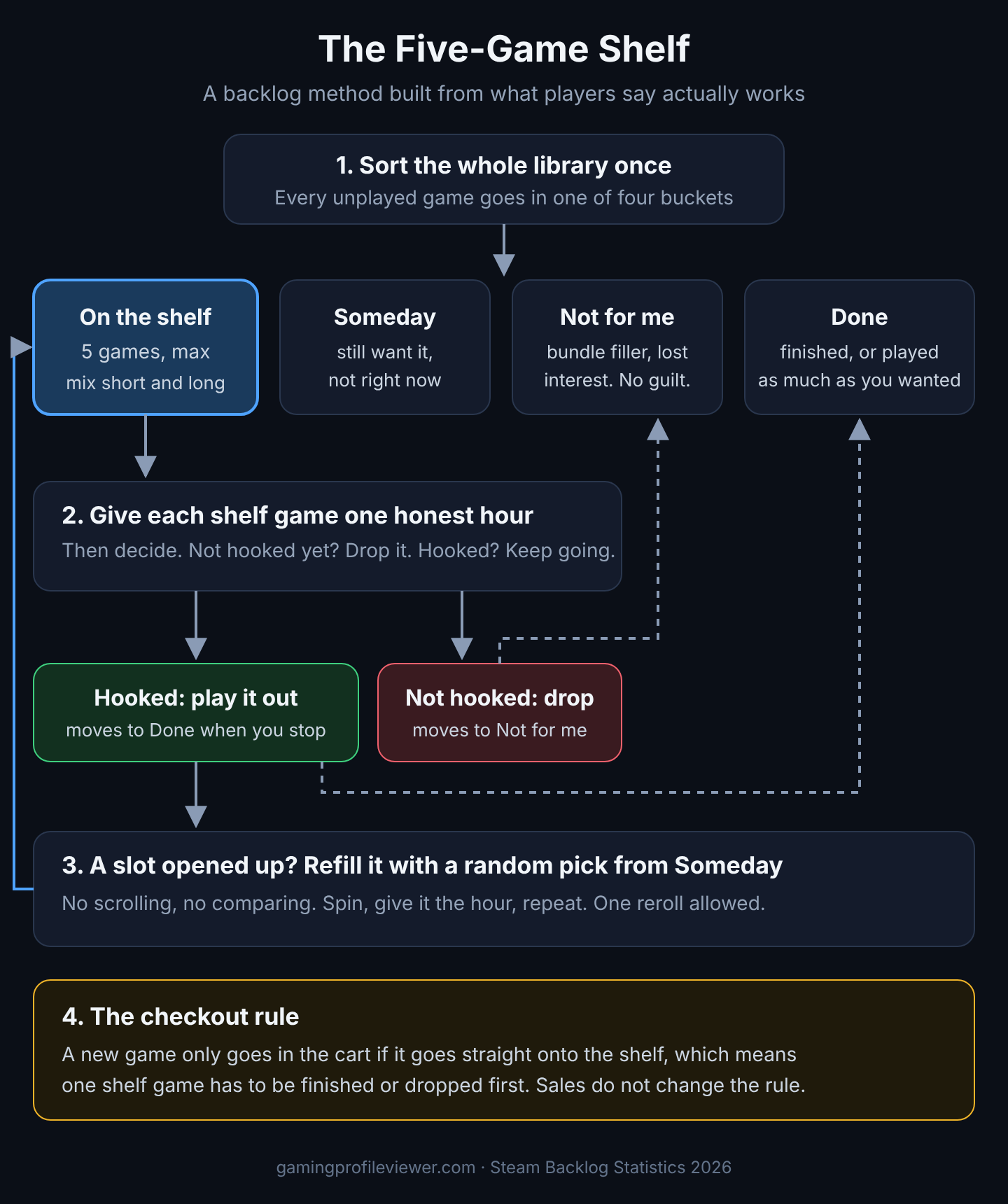 The Five-Game Shelf: sort once, keep five, give each an hour, refill at random.
1. Sort the whole library once
Go through every unplayed and barely played game one time and put each in a bucket: On the shelf, Someday, Not for me, or Done. Be ruthless with Not for me. Bundle filler you were never going to play belongs there, and moving it is not admitting failure. It is admitting you were never going to play it. The backlog calculator does this sort for you and remembers it in your browser.
2. Keep five games on the shelf, never more
Five is enough to cover moods (something short, something long, something you can play on a Steam Deck in bed) and few enough that choosing is easy. In the same NeoGAF thread about scrolling past hundreds of games, keeping a short active list is one of the fixes people say actually worked.
3. Give each shelf game one honest hour
Play it for an hour. Then decide. Hooked: keep going until you are done with it, whatever done means to you. Not hooked: move it to Not for me and do not look back. For a new purchase, Steam's refund window gives you the same test with your money on the line: under two hours played and within 14 days.
4. Refill the shelf at random
When a slot opens, do not browse. Spin the random game picker on your Someday pile and put whatever comes up on the shelf. You get one reroll. This is the step that removes the 10pm scrolling.
5. The checkout rule
A new game only goes in the cart if it goes straight onto the shelf. That means something on the shelf has to be finished or dropped first. A sale does not change the rule. If the game will still be on sale again in a few months, and it almost always will be, nothing is lost by waiting.
A worked example
Take the median 100+ game library from our sample: 145 games, 42 never launched, 24 played for under an hour.
- Sort once. Say a third of the 66 unplayed or barely played games are bundle filler and giveaways you were never going to touch. That is 22 straight to Not for me, which leaves 44: 5 on the shelf and 39 in Someday.
- The hour test. Giving every remaining game one honest hour is about 44 hours. At 10 hours of gaming a week, that is roughly four and a half weeks to know exactly which games deserve more of your time.
- The result. Instead of a pile of 66 you feel bad about, you have five games you are playing, a sorted Someday list that shrinks every time a game fails its hour, and a checkout rule that stops the next sale from undoing it.
Check your own backlog
- Steam Backlog Calculator: paste a public profile and see your never-launched count, how you compare with this study, what the pile lists for today, how long it would take at your pace, and sort everything into the four buckets. Save a snapshot and come back in a month to see whether it is shrinking.
- Random Steam Game Picker: pick from games you have never launched, played under an hour, or only from your shelf. Add a friend's profile to pick something you both own.
- Steam Stats: your most played games and total hours, if you want to see where the time actually went.
Both tools need your game details set to public. Here is how to change that, and you can switch it back afterwards.
FAQ
What percentage of Steam games are never played? In our October 2026 random sample of 280 public libraries, 28% of all owned games had zero minutes played. The median library had 14% never launched. Libraries of 100 or more games sat at 30%.
How big is the average Steam backlog? It depends heavily on which average. The median public library in our sample owned 7 or 8 paid games and had never launched 1. The mean was 8.7 never-launched games, pulled up by collectors with hundreds. One in ten libraries had 21 or more.
Is having a gaming backlog bad? Not by itself. Lots of players treat a big library as something to look forward to. It becomes a problem when the size of it stops you from playing anything, or when you keep buying to feel like you are making progress.
How do I see how many Steam games I have never played? Paste your profile into the backlog calculator. It counts games with zero minutes, under an hour and under two hours. Inside Steam you can sort the library by hours played, which the hours played guide walks through.
Does Steam count a game as played if I only opened it? Yes. Any recorded minutes move a game off zero, which is why we report under an hour separately. Card idling tools also mark games as played, and very old games you played before Steam began tracking playtime in 2009 can still show zero. How Steam tracks playtime covers the gaps.
How long would it take to finish my backlog? Multiply the number of games by how long a game usually takes you, then divide by your hours per week. The median 100+ game library in our sample has 42 never-launched games. At 10 hours per game and 10 hours a week, that is 42 weeks, or about ten months, before counting anything bought along the way. The backlog calculator does the sum with your own numbers.
What is the best way to pick what to play from my backlog? Take the decision away from yourself. Keep a short list, and when you cannot choose, let a random picker do it and commit to an hour.
Methodology and limits
How we sampled. Every Steam account has a numeric account ID, and newer accounts get higher numbers. On October 2, 2026 we found the highest ID in use (about 1.93 billion), then drew random IDs between 1 and that number through the official Steam Web API. For each ID that turned out to be a real account with a public profile, we requested its owned games with GetOwnedGames. We stored no Steam IDs, names or anything else that could identify a person: only game counts, playtime totals and the year each account was created.
What counts as never launched. A game with zero minutes of recorded playtime. Steam has tracked playtime since early 2009, so a game only played before then can show zero. Offline sessions do not always sync, and card idling tools mark games as played. Free-to-play games are excluded because Steam only lists them after they have been played.
Who we left out. 45 libraries showed zero minutes on every single game, including four libraries of over 100 games. That pattern is consistent with Steam's separate "always keep my total playtime private" setting, so we excluded them. Some were probably genuinely untouched accounts, and counting the small ones back in nudges the overall never-launched share from 27.8% to 28.1%.
How big the sample is. About 6,000 random IDs led to roughly 5,200 real accounts, 525 with visible game details, and 280 usable libraries holding 8,719 paid games. That is enough to be confident in the overall figures (we report a 95% range from bootstrap resampling where it matters) but thin for small groups. The 100+ game group is 19 libraries, so treat those medians as indicative. Steam's API started rate limiting us after a few thousand requests, so this is wave one. We plan to add to it each month and report the larger sample.
Prices. US store prices, taken through Steam's store service on October 2, 2026 during the Autumn Sale, for the 169 libraries where we kept game-level detail. "Full price" is the undiscounted list price and "sale price" is what the game cost that day.
Who we are. Gaming Profile Viewer makes free Steam, Xbox and PlayStation stats tools, including the backlog calculator built on this study.
Last updated: October 2, 2026. We plan to re-run the sample after the Steam Winter Sale and again for the 2027 edition. Trending figures we will watch: the share of libraries showing game details publicly, and whether the never-launched share moves after big sales.
Sources
- Over one third of purchased Steam games have never been played (Steam Gauge, 2014), Game Informer
- How many PC games get bought, but not played?, GameDiscoverCo
- Steam users have $19 billion of unplayed games, PCGamesN
- The math on unplayed Steam "shame" is way off, Ars Technica (mirror)
- CNN report: only 10 percent of players finish games, Game Informer
- Bailey and Miyata, game completion on Steam, Entertainment Computing (2019)
- Alinea Analytics on Steam H1 2026 revenue, GameDev Reports
- Steam Replay 2025: 14% of playtime on 2025 releases, GamingOnLinux
- Steam users spent only 15% of their time on 2024 releases, GameDev Reports
- Steam Replay 2023 playtime by release year, Automaton
- Revenge of Steam's mid-market, SuperJoost (GYLD data)
- Wishlists, Steamworks documentation
- Steam Autumn Sale 2026, Steamworks documentation
- Steam refunds, Valve
- 62% of hardcore players no longer buy full price games, VGC
- People Aren't Buying New Games, So Valve Changed Steam, Bellular News
- DellaVigna and Malmendier, Paying Not to Go to the Gym, American Economic Review (2006)
- Scheibehenne, Greifeneder and Todd, Can There Ever Be Too Many Options? (2010)
- Chernev, Bockenholt and Goodman, Choice overload: a conceptual review and meta-analysis (2015)
- Steam Web API, Valve Developer Community
- IPlayerService (GetOwnedGames), Steamworks documentation
- How to change Steam privacy settings, gHacks
- How big is your backlog?, Steam Community
- How big is your gaming backlog?, NeoGAF
- Backlog scrolling and "nothing to play", NeoGAF
- Steam users have spent $19 billion on games they've never played, NeoGAF discussion
- Methods for working on gaming backlogs, NeoGAF
- May 2024 Backlog Burner recap, Tildes
- May 2025 Backlog Burner recap, Tildes
- Free upgrade, bundle and giveaway sources for each game are linked in the table above.