Published Oct 7, 2026 · 17 min read
Console prices in 2026: every hike tracked and adjusted for inflation
Short answer: in the US a PS5 now costs $649.99, an Xbox Series X $799.99, a Switch 2 $499.99 and a 512GB Steam Deck OLED $789. Every one of them costs more than it did at launch. But once you adjust for inflation the picture splits. The PS5 disc model costs almost exactly what it did in November 2020 in real terms (up 1%). The Xbox Series S is up 29.5% after inflation and the Steam Deck OLED is up 32%, the biggest real increases of any mainstream gaming hardware. The deeper change is that consoles stopped getting cheaper as they aged. At the same point in their lives, the PS1, PS2 and PS3 sold for roughly a third of their launch price in real terms.
Last updated October 7, 2026. Prices are US list prices from official announcements. Inflation uses the August 2026 consumer price index, the latest released. We update this page after every price change and each new CPI release.
Key takeaways
- Nine separate price increases hit US consoles, handhelds and VR headsets between May 2025 and September 2026. Xbox alone raised prices three times.
- After inflation, the PS5 disc model is up 1% since launch, the Series X 24%, the Series S 29.5% and the Steam Deck OLED 32%. The original Switch is down 17.5%.
- Past consoles lost half to two thirds of their real price within two to five years. On the PS2's path, a PS5 would cost about $240 today, not $649.99.
- The 2026 hikes are about memory. Microsoft says its memory and storage costs rose "more than 2.5x". No forecast we found sees DRAM prices easing before 2028.
- Prices are working against sales: US hardware units fell 39% in July 2026 while the average price paid rose 16% to $542.
On this page: Current prices · Adjusted for inflation · Consoles stopped getting cheaper · Every price change · Why prices keep rising · Sales impact · Subscriptions and games · What players are doing · Will prices go down? · Buy, wait or refurb · FAQ · Method
Current US console prices
| Device | US launch | Launch price | Price now | Change | After inflation |
|---|---|---|---|---|---|
| PS5 (disc) | Nov 2020 | $499.99 | $649.99 | +30% | +1.0% |
| PS5 Digital | Nov 2020 | $399.99 | $599.99 | +50% | +16.5% |
| PS5 Pro | Nov 2024 | $699.99 | $899.99 | +29% | +21.1% |
| PlayStation Portal | Nov 2023 | $199.99 | $249.99 | +25% | +14.6% |
| Xbox Series X | Nov 2020 | $499.99 | $799.99 | +60% | +24.3% |
| Xbox Series S (512GB) | Nov 2020 | $299.99 | $499.99 | +67% | +29.5% |
| Nintendo Switch 2 | Jun 2025 | $449.99 | $499.99 | +11% | +7.0% |
| Nintendo Switch OLED | Oct 2021 | $349.99 | $399.99 | +14% | -5.6% |
| Nintendo Switch | Mar 2017 | $299.99 | $339.99 | +13% | -17.5% |
| Steam Deck OLED 512GB | Nov 2023 | $549 | $789 | +44% | +31.7% |
| Steam Deck OLED 1TB | Nov 2023 | $649 | $949 | +46% | +34.0% |
| Steam Machine 512GB | Jun 2026 | $1,049 | $1,049 | none yet | none yet |
| Steam Frame 256GB | Sep 2026 | $1,059 | $1,059 | none yet | none yet |
| Meta Quest 3S 128GB | Oct 2024 | $299.99 | $349.99 | +17% | +9.9% |
"After inflation" compares today's price with the launch price converted to August 2026 dollars. A PS5 that cost $499.99 in November 2020 works out to $643.61 in today's money, so $649.99 is only 1% more in real terms. Sources for every row are in the ledger below and our method.
Console price tracker
Pick up to five devices and switch between list prices and today's dollars. Hover or tap the chart for the price in any month.
List prices as announced by each company. Months after a change show the new price.
| Device | Launch | Launch price | Now | Change | After inflation |
|---|---|---|---|---|---|
| PS5 (disc) | Nov 2020 | $499.99 | $649.99 | +30% | +1.0% |
| PS5 Digital | Nov 2020 | $399.99 | $599.99 | +50% | +16.5% |
| PS5 Pro | Nov 2024 | $699.99 | $899.99 | +29% | +21.1% |
| PlayStation Portal | Nov 2023 | $199.99 | $249.99 | +25% | +14.6% |
| Xbox Series X | Nov 2020 | $499.99 | $799.99 | +60% | +24.3% |
| Xbox Series S (512GB) | Nov 2020 | $299.99 | $499.99 | +67% | +29.5% |
| Nintendo Switch OLED | Oct 2021 | $349.99 | $399.99 | +14% | -5.6% |
| Nintendo Switch | Mar 2017 | $299.99 | $339.99 | +13% | -17.5% |
| Nintendo Switch 2 | Jun 2025 | $449.99 | $499.99 | +11% | +7.0% |
| Steam Deck OLED 512GB | Nov 2023 | $549.00 | $789.00 | +44% | +31.7% |
| Steam Deck OLED 1TB | Nov 2023 | $649.00 | $949.00 | +46% | +34.0% |
| Steam Machine 512GB | Jun 2026 | $1,049.00 | $1,049.00 | 0% | -0.3% |
| Steam Frame 256GB | Sep 2026 | $1,059.00 | $1,059.00 | 0% | 0.0% |
| Meta Quest 3S 128GB | Oct 2024 | $299.99 | $349.99 | +17% | +9.9% |
Adjusted for inflation, who actually raised prices?
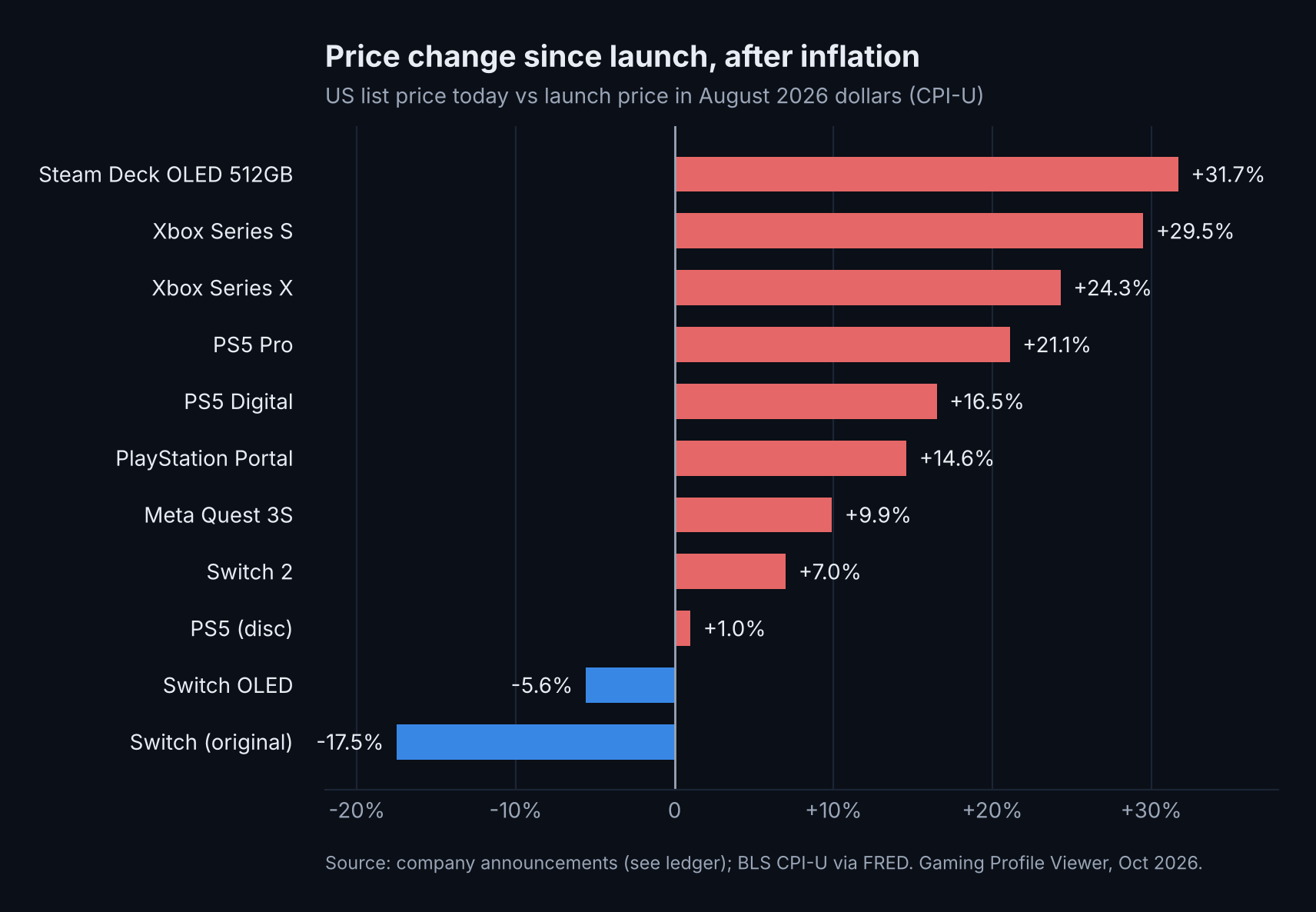 Xbox and Valve raised prices well ahead of inflation. Sony's disc PS5 has only kept pace with it. Source: company announcements, BLS CPI-U via FRED.
Headlines treat every hike the same, but they aren't. US prices rose about 29% between November 2020 and August 2026 (the consumer price index went from 260.2 to 335.0), so any console that is up less than that has actually gotten a little cheaper in real terms, and anything above it has gotten more expensive.
Three groups fall out of the numbers:
- Above inflation: Xbox and Valve. The Series S went from $299.99 to $499.99 across three increases, a 29.5% real rise. The Steam Deck OLED jumped from $549 to $789 in a single May 2026 change, 32% above its launch price after inflation.
- Roughly matching inflation: the PS5 disc model. Two increases took it from $499.99 to $649.99. That sounds steep, and it is if you remember 2020 prices, but in real terms Sony is charging what it charged at launch.
- Below inflation: the original Switch family. Nintendo raised the Switch, OLED and Lite in August 2025, but the original Switch launched in 2017, so it is still 17.5% cheaper in real terms than on day one.
The PS5 Digital is the odd one out at Sony. It went up more than the disc model in percentage terms because the 2023 Slim redesign already moved it from $399.99 to $449.99 before any official "price increase" was announced.
Consoles used to get cheaper. This generation didn't
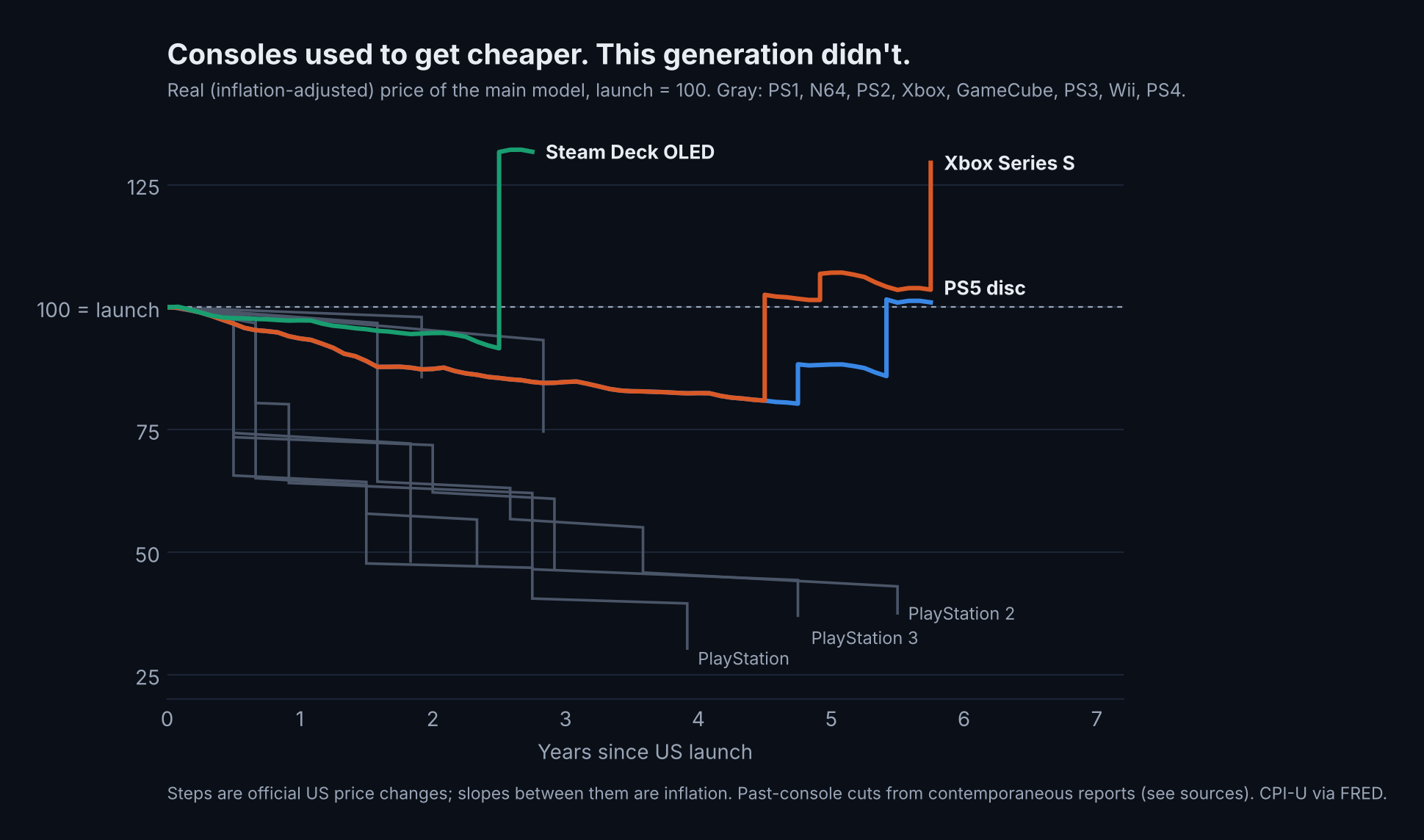 Every past console we tracked fell in real price within two to three years. The current generation drifted down only through inflation, then jumped back up. The PS5 and Series S lines overlap until 2025. Source: our price ledger; past-console cuts from contemporaneous reports.
This is the part most coverage misses. The sticker price of a new console has always been high: the 60GB PS3 launched at $599.99 in 2006, which is about $997 in today's dollars. What changed is the second half of the life cycle.
We rebuilt the US price history of nine earlier consoles from news reports of each official cut and adjusted every point for inflation. The pattern is consistent:
| Console | Launch | Last cut we tracked | Real price vs launch at that point |
|---|---|---|---|
| PlayStation | $299 (Sep 1995) | $99 (Aug 1999, 3.9 years in) | 30% |
| PlayStation 2 | $299 (Oct 2000) | $129.99 (Apr 2006, 5.5 years in) | 38% |
| PlayStation 3 | $599.99, 60GB (Nov 2006) | $249.99 (Aug 2011, 4.75 years in) | 37% |
| Nintendo 64 | $199.99 (Sep 1996) | $99 (Aug 1999, 2.9 years in) | 47% |
| Xbox | $299 (Nov 2001) | $149.99 (Mar 2004, 2.3 years in) | 47% |
| GameCube | $199 (Nov 2001) | $99.99 (Sep 2003, 1.8 years in) | 48% |
| PS5 (disc) | $499.99 (Nov 2020) | none, two increases | 101% at 5.75 years |
| Xbox Series S | $299.99 (Nov 2020) | none, three increases | 130% at 5.75 years |
The PS2 line is the cleanest comparison because it covers a similar span. CNN reported the $199 cut in May 2002, Game Developer covered $179 in 2003, and NBC News reported the roughly $130 price in April 2006. By then the PS2 cost 38% of its real launch price. Apply the same path to the PS5 and you get a console that would sell for about $240 today. Ars Technica's 2025 analysis, using a different method, put the "historical" PS5 Digital price at $229. Two separate approaches land in the same place: the PS5 costs roughly $400 more than history says it should.
Was a mid-generation increase ever seen before? Not in US list prices on a major console, as far as we could find. It did happen in other countries: the PS4 went up in Canada in March 2014, and the PS5 rose in Europe and Japan in August 2022 while the US was left alone. The first US list-price increases on current consoles came in 2025.
Every price change since 2025, in order
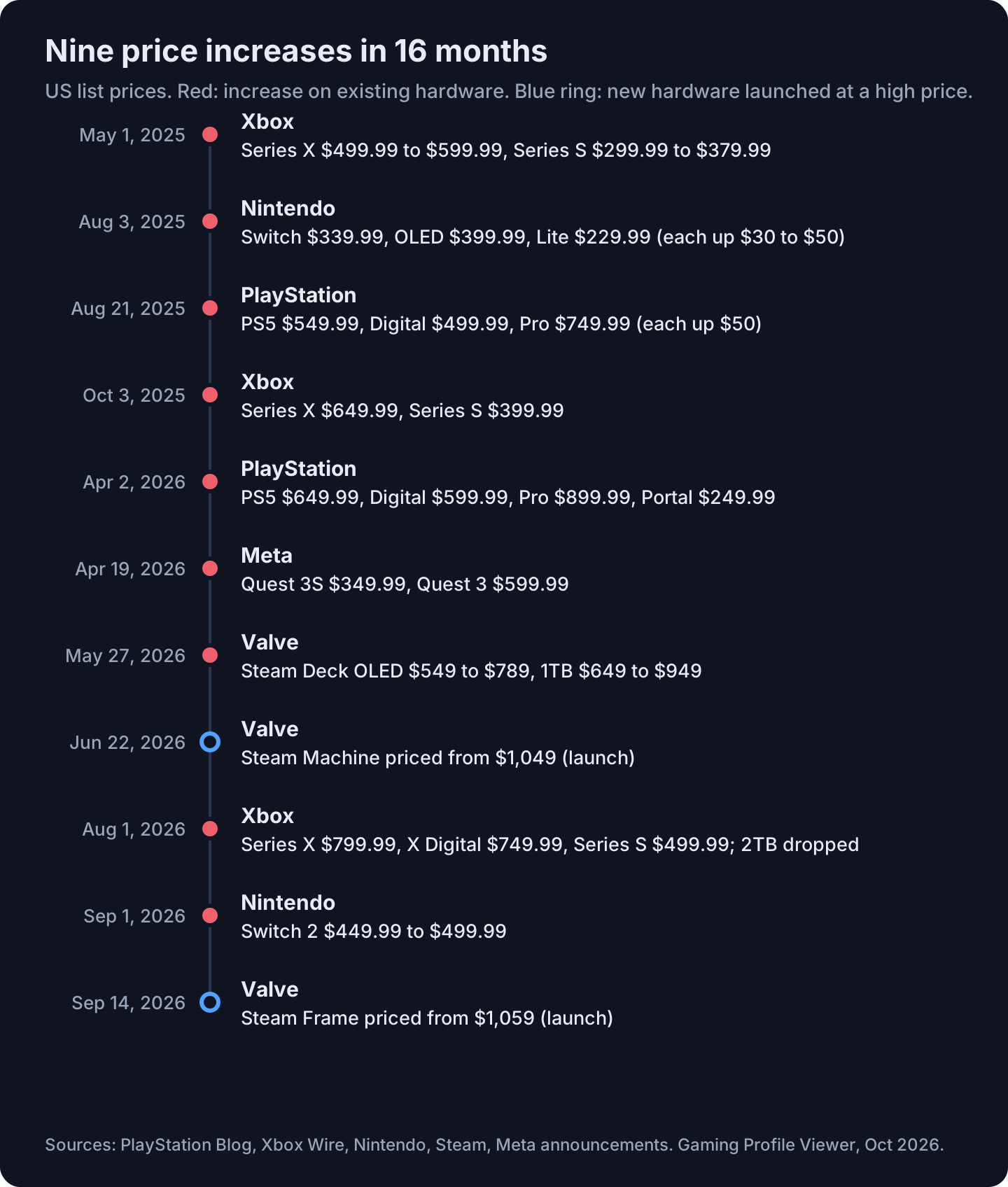 Nine increases in 16 months, with Xbox raising prices three times. Sources: PlayStation Blog, Xbox Wire, Nintendo, Steam and Meta announcements.
PS5 price history
| Date | PS5 (disc) | PS5 Digital | PS5 Pro | Source |
|---|---|---|---|---|
| Nov 2020 launch | $499.99 | $399.99 | n/a | PlayStation Blog |
| Nov 2023 Slim | $499.99 | $449.99 | n/a | Game Informer |
| Nov 2024 | $499.99 | $449.99 | $699.99 | Shacknews |
| Aug 21, 2025 | $549.99 | $499.99 | $749.99 | PlayStation Blog |
| Apr 2, 2026 | $649.99 | $599.99 | $899.99 | PlayStation Blog |
Sony blamed a "challenging economic environment" in 2025 and "continued pressures in the global economic landscape" in 2026. The April 2026 increase also took the PlayStation Portal from $199.99 to $249.99. Neither post mentions memory by name, but Sony's own May 2026 filing says it will plan PS5 production around "the volume of memory we can procure at reasonable prices".
Xbox Series X and Series S price history
| Date | Series X | Series X Digital | Series S 512GB | Series S 1TB | Source |
|---|---|---|---|---|---|
| Nov 2020 launch | $499.99 | n/a | $299.99 | n/a | TechCrunch |
| May 1, 2025 | $599.99 | $549.99 | $379.99 | $429.99 | Windows Central |
| Oct 3, 2025 | $649.99 | $599.99 | $399.99 | $449.99 | Gematsu |
| Aug 1, 2026 | $799.99 | $749.99 | $499.99 | $599.99 | Xbox Wire, Windows Central |
The August 2026 change also discontinued the 2TB Galaxy Black Series X, which had reached $799.99. Microsoft was the most direct of the three about cost: its Xbox Wire post says console "storage and memory prices have increased by more than 2.5x" and that it expects "another doubling by the fall of 2027". If you own one already, our Xbox account value tool shows what your library is worth.
Nintendo Switch and Switch 2 price history
| Date | Switch 2 | Switch OLED | Switch | Switch Lite | Source |
|---|---|---|---|---|---|
| Launch | $449.99 (Jun 2025) | $349.99 (Oct 2021) | $299.99 (Mar 2017) | $199.99 | Nintendo (Switch 2), Gematsu (Switch family) |
| Aug 3, 2025 | $449.99 | $399.99 | $339.99 | $229.99 | Gematsu |
| Sep 1, 2026 | $499.99 | $399.99 | $339.99 | $229.99 | Nintendo |
Nintendo gave nearly four months' notice of the Switch 2 increase (announced May 8, 2026), the longest of any company. The Mario Kart World bundle came back at $549.99 after the change. Nintendo's own forecast of 16.5 million Switch 2 units this fiscal year, against 19.86 million last year, is a drop of about 17%.
Steam Deck, Steam Machine and Steam Frame prices
| Date | Device | Price | Source |
|---|---|---|---|
| Nov 2023 | Steam Deck OLED 512GB / 1TB | $549 / $649 | VGC |
| Dec 2025 | Steam Deck LCD 256GB | discontinued | Tom's Guide |
| May 27, 2026 | Steam Deck OLED 512GB / 1TB | $789 / $949 | Steam |
| Jun 22, 2026 | Steam Machine 512GB / 2TB | $1,049 / $1,349 | GamingOnLinux |
| Sep 14, 2026 | Steam Frame 256GB / 1TB | $1,059 / $1,299 | Dexerto |
Valve wrote that its "original goal for the price of Steam Machine is no longer viable", and that the final prices reflect components bought over the previous six months (via 80.lv). With the LCD Deck gone, the cheapest new way into Valve hardware is now $789. Our guides on how much a Steam Deck costs and whether it is still worth it go deeper on the handheld.
Meta raised the Quest 3S from $299.99 to $349.99 and the Quest 3 from $499.99 to $599.99 on April 19, 2026, citing memory costs (Game Informer).
Why prices keep going up: the price ratchet
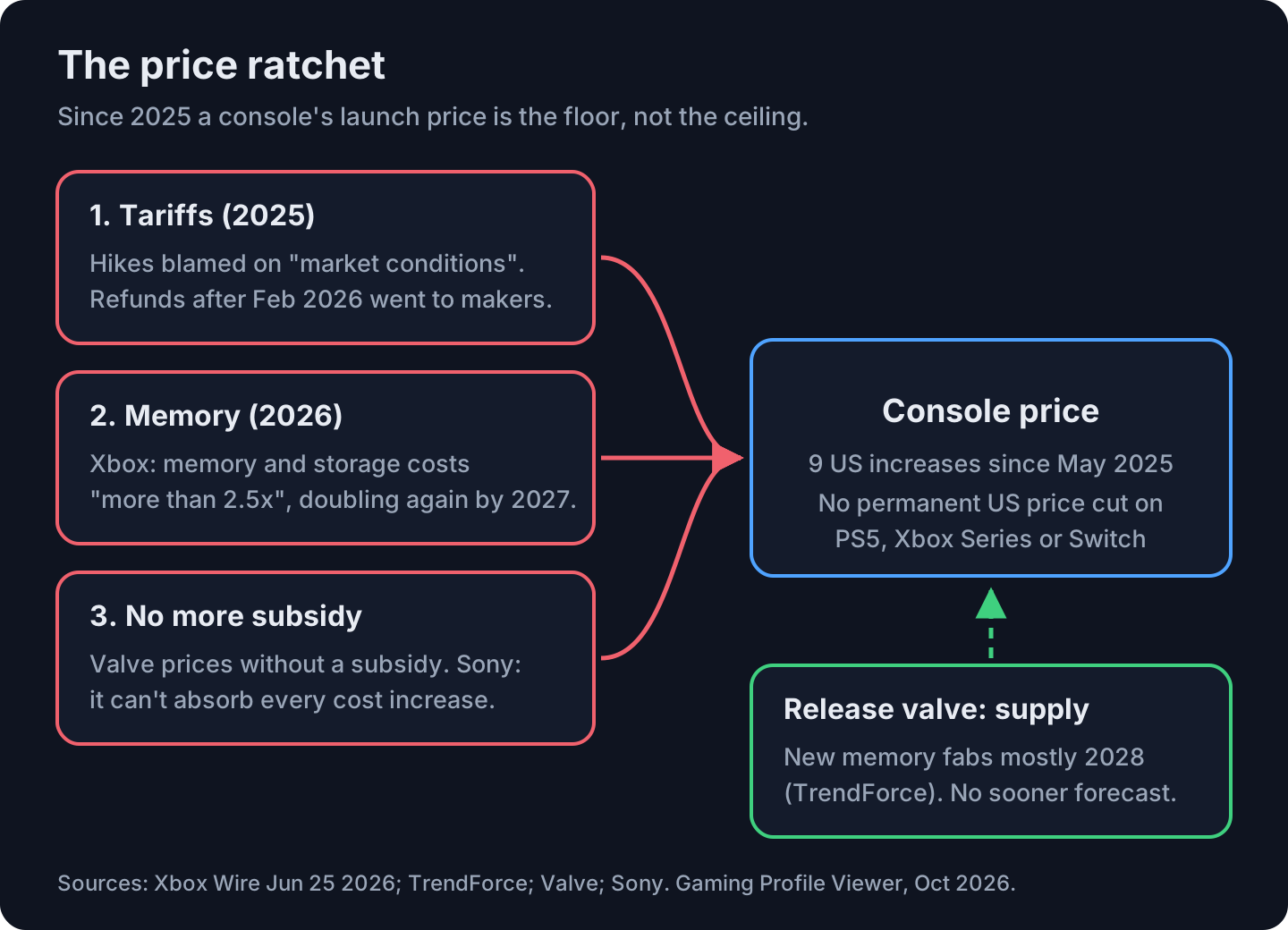 Three forces push prices up and nothing pushes back until memory supply grows.
We call it the price ratchet. A ratchet turns one way. Since 2025, a console's launch price has acted as a floor instead of a ceiling, and three separate forces have each clicked it up a notch.
1. Tariffs (2025). The 2025 increases arrived alongside new US import tariffs, even though the companies talked about "market conditions" and the "economic environment". In February 2026 the Supreme Court ruled 6 to 3 in Learning Resources v. Trump that the IEEPA tariffs were unlawful (Bradley's summary). Refunds go to importers, not shoppers. Sony expects about ¥80 billion back (around $500 million at current exchange rates) (Nasdaq summary of Sony's call), and both Sony and Microsoft told courts they owe buyers nothing. Nintendo went a different way: its September 12 to 26 Customer Appreciation Sale was, in its words, "made possible in part by tariff-related refunds". Console list prices didn't come back down at any of the three.
2. Memory (2026). This is the big one. AI data centers are buying high-bandwidth memory and server DRAM, and the three big chipmakers have shifted capacity to serve them. TrendForce reported conventional DRAM contract prices up 45% to 50% in a single quarter at the end of 2025, then forecast PC DRAM up another 105% to 110% in early 2026, which it called "the largest quarterly price surge on record". Micron quit selling Crucial consumer memory to focus on data centers. You can see it at retail: the cheapest 32GB DDR5-6000 kit was $429 in late September, against a record low of $72 on Tom's Hardware's index, roughly six times higher. A console is a box of memory and storage around a custom chip, so it feels this directly.
3. No more subsidy. Console makers used to sell hardware near or below cost and make it back on games. That model is fading. Sony's Hideaki Nishino said it is "not realistic for us to absorb all component cost increases", and Valve says the Steam Machine's price simply reflects what its components cost over the previous six months.
The one thing that could turn the ratchet back is supply. TrendForce expects DRAM to stay tight through 2027 with most new fabs arriving in 2028. Micron's CEO said in September 2026 that the company has no "line of sight" to when supply and demand balance.
What the hikes did to sales
Higher prices are selling fewer consoles to fewer, richer people. Circana's US data, reported by Mat Piscatella:
- May 2026: PS5 unit sales fell 58% year on year and the average PS5 sold for $672. Xbox had its worst May on record.
- July 2026: hardware spending fell 29% to $282 million, the lowest since July 2020. Units fell 39%, while the average price paid rose 16% to $542 (GamesBeat, PlayNews).
- The buyer is changing. Talking to Christopher Dring at The Game Business in June, Piscatella put the average console price at about $250 in 2019 and said it will probably pass $500. Well over half of hardware buyers now come from households earning $100,000 or more.
Valve saw the same thing. Boiling Steam estimated from Steam's top-seller rankings that Steam Deck sales dropped about 82% after the May increase. Valve hasn't confirmed that, so treat it as an informed estimate.
Subscriptions and games: the rest of the bill
The console is only the entry fee. Here is what the recurring costs did:
| Service (US) | 2020 | Now | What changed |
|---|---|---|---|
| Xbox Game Pass Ultimate | $14.99/mo | $22.99/mo | Rose to $29.99 in Oct 2025, then cut to $22.99 in Apr 2026, with new Call of Duty games now arriving about a year after launch |
| PC Game Pass | $9.99/mo | $13.99/mo | Peaked at $16.49 in Oct 2025 |
| PS Plus Essential, 12 months | $59.99 | $79.99 | Raised in Sep 2023; monthly plans rose again in May 2026 |
| PS Plus Extra, 12 months | $99.99 (launched 2022) | $134.99 | Raised Sep 2023 |
| Nintendo Switch Online | unchanged in the US | unchanged | Japan and Korea went up in July 2026 |
Game Pass is the only place in this article where prices came down in 2026: Ultimate and PC Game Pass were both cut on April 21, and both still cost more than in 2020. Xbox said the change "responds to a lot of feedback" from players.
Games moved too. The $69.99 standard arrived with the PS5 generation (NBA 2K21 was first), Nintendo put Mario Kart World at $79.99 in 2025, and Microsoft backed away from $79.99 after announcing it. GTA VI lands on November 19 at $79.99 standard and $99.99 Ultimate, on PS5 and Xbox Series. A new PS5 and a standard copy of GTA VI is $729.98 before tax.
What players are doing about it
Across news comment sections, Hacker News threads and deal forums, the pattern is consistent. Very few people say they are switching platforms over price. Far more are buying early, buying used, or not buying at all.
- Buying before the hike works, and people know it. US PS5 sales hit their 2026 high in the week the April 2 increase took effect. Switch 2 shoppers had four months' warning and used it.
- Bundles at the old price. For a while, Nintendo's $499.99 "Choose Your Game" bundle cost the same as the console alone does now, with Mario Kart World, Donkey Kong Bananza or Pokémon Pokopia included.
- Used and refurbished demand jumped, and so did refurb prices. Gumtree saw used console enquiries up 93% in the UK after the PS5 increase. Sony then raised its own certified refurbished PS5 prices by $100 on May 1, 2026, and Valve's refurbished Steam Decks ($319 to $519 in March) sell out within hours of a restock.
- Skipping the generation. In a Push Square reader poll of nearly 2,000 votes, only 13% said the PS5 was worth its new price. It's an open poll, not a survey, but the comments match what we saw elsewhere: people keeping a PS4 running or holding off.
- PC isn't the escape it used to be. The Hacker News thread on memory prices (675 points) is full of people reporting RAM and SSD prices doubling or worse and deciding not to upgrade at all. Median RTX 5070 prices reached $899.99 against a $549 launch price in August.
The most repeated complaint is the tariff one. Buyers paid prices that included tariffs, the tariffs were struck down, and the refunds went to the companies. Nintendo's sale is the only case where any of that money visibly reached customers.
Will console prices go down?
Probably not soon. Three reasons:
- Memory stays tight into 2028. TrendForce expects DRAM to stay short through 2027, with most new fabs opening in 2028. Micron told investors supply will be "much tighter" in its fiscal 2027 and 2028, and SK hynix said in July that the supply and demand balance is unlikely to improve meaningfully in the near term. NAND (storage) may ease a bit sooner, in the second half of 2027.
- Microsoft expects worse, not better. Its June 2026 post predicts memory costs doubling again by fall 2027.
- The next generation is being priced up, not down. Estimates for the PS6 and Microsoft's next Xbox range from $600 to $800 if memory eases (S&P Global's Neil Barbour) to Joost van Dreunen's view that "a $1,000 console will be the norm". Ampere Analysis estimates a $1,000 launch could cut combined sales by nearly 40% over five years, which gives the platform holders a strong reason to find a way under it.
Sales and bundles are a different story from list prices. Expect Black Friday deals that bring the effective price closer to the old one. Just don't expect the official US price of a PS5 or Xbox to fall back to 2025 levels while memory costs are where they are.
Buy now, wait, or go refurbished?
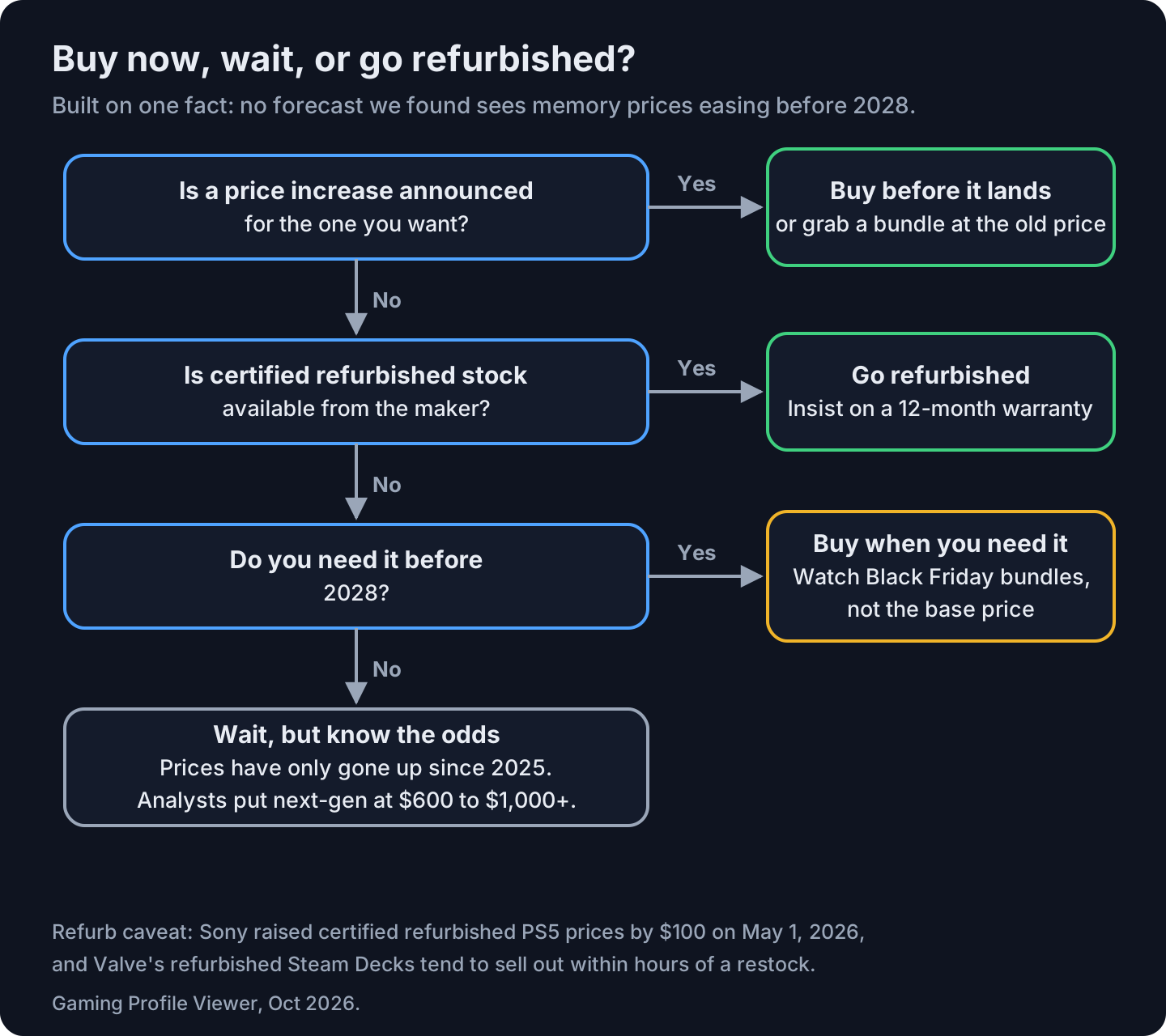 Waiting for a price drop has been a losing bet since 2025. Waiting for a bundle hasn't.
Our take: if you know you want a console in the next year or two, the waiting game is working against you. Every list price in this article has gone one way since May 2025. The money is in timing (buying before an announced increase), bundles (a game thrown in at the same price) and certified refurbished units with a full warranty. If you're on PC, check what your Steam account is worth before deciding whether a new console makes sense at all, and keep an eye on Steam sale dates for the games themselves.
FAQ
How much is a PS5 right now? In the US, $649.99 for the disc model, $599.99 for the Digital Edition and $899.99 for the PS5 Pro, since April 2, 2026.
How much is an Xbox Series X now? $799.99 for the disc model and $749.99 for the Digital model since August 1, 2026. The Series S is $499.99 (512GB) or $599.99 (1TB).
Why did the Switch 2 go up to $499.99? Nintendo cited "changes in market conditions" when it announced the September 1, 2026 increase. In August, president Shuntaro Furukawa pointed to a surge in memory and component costs.
Why does six-year-old hardware cost more than at launch? Mostly memory. The PS5 and Xbox Series use far more DRAM and flash than earlier consoles, and those prices have multiplied since late 2025. Tariffs added to it in 2025, and console makers are no longer willing to absorb the difference.
Is this the first time consoles went up in price? For US list prices on a major console, it's the first time we could find. Prices have risen before in other countries, including the PS4 in Canada in 2014 and the PS5 in Europe and Japan in 2022.
Will prices go down on Black Friday? Deals and bundles, probably. A permanent cut to list prices is unlikely while memory stays expensive.
Did I get a tariff refund? No. Refunds go to the importer of record, which is the console maker. Sony and Microsoft have told courts they owe buyers nothing; consumer lawsuits are ongoing.
Is a refurbished console worth it? A certified refurb from Sony, Valve or a major retailer with a 12-month warranty is the closest thing to the old prices right now. Stock is thin and Sony raised its refurb prices too, so check often.
Methodology and sources
- Prices: US list prices (MSRP) from official announcements on PlayStation Blog, Xbox Wire, Nintendo and Steam, with reputable outlets used where a company didn't publish per-model prices. Temporary sales and bundles are excluded. The full ledger, one source per row, is in our data file.
- Inflation: we convert launch prices to August 2026 dollars using the US CPI for all urban consumers, not seasonally adjusted (BLS series CUUR0000SA0, read from FRED). August 2026 = 334.980. The October 2025 index was never published because of the federal shutdown, so we use September 2025 for the October 2025 Xbox change. The September 2026 CPI is due October 14 and will be added then.
- Past consoles: we rebuilt price paths for the PlayStation, Nintendo 64, PlayStation 2, Xbox, GameCube, PlayStation 3, Wii, Wii U and PlayStation 4 from contemporaneous news reports of each official US price cut. Where a model changed (the 40GB PS3, the PS3 Slim), we follow the cheapest current model. The mid-1996 PlayStation cut is dated to May 1996 as an approximation.
- What we left out: the PS4 and Xbox One after their first cuts, because we couldn't source every later US change.
- Updates: we revisit this page after every US price change, every CPI release and when Circana publishes new monthly data.
Numbers you may see elsewhere that are wrong or stale
- Several ranking pages still list the Switch 2 at $449.99 (it has been $499.99 since September 1, 2026) or the PS5 at $549.99 (it has been $649.99 since April 2, 2026).
- One widely shared page claims Sony rolled the PS5 Digital back to $499.99 in August 2026. We found no announcement supporting that.
- Some coverage describes the 2025 increases as the first time a console ever got more expensive. That holds for US list prices, but the PS4 went up in Canada in 2014 and the PS5 in Europe and Japan in 2022.
- Nintendo's Switch 2 forecast (16.5 million units against 19.86 million) implies a drop of about 17%. Check that figure if you see a smaller one quoted.